ASHRAE 90.1 is the energy standard that most commercial buildings in the United States are built to. The standard contains specific, mandatory requirements for how valves and their actuators must behave at the equipment level, at the plant level, and across the distribution system. Some of those requirements have direct bearing on product selection. Others create obligations that flow commissioning alone cannot satisfy.
This post covers what Section 6 of ASHRAE 90.1 actually says about valve and actuator controls, where the requirements are mandatory versus prescriptive, and what that means for projects in design or existing systems being upgraded.
Table of Contents
ASHRAE 90.1 Requirements: Mandatory vs. Prescriptive
Before getting into specific valve requirements, it helps to know where to look and what the difference between requirements actually means.
Section 6 of ASHRAE 90.1 governs HVAC systems and covers everything from equipment efficiency minimums to system-level controls. It divides requirements into two categories:
- Mandatory provisions (Section 6.4) — These apply regardless of which compliance path the project uses. There are no trade-offs or alternatives. Failure to meet them is a code violation.
- Prescriptive provisions (Section 6.5) — These are the default compliance requirements for systems and plants. They can be traded against each other under the energy cost budget method or, starting with the 2022 edition, under the new Total System Performance Ratio (TSPR) path.
Valve and actuator requirements appear in both categories. Understanding which is which matters because prescriptive requirements can sometimes be addressed through alternate compliance methods, while mandatory requirements cannot.
Mandatory Controls: Section 6.4
Automatic Shutdown and Setback
Section 6.4.3 requires that HVAC systems be capable of automatic shutdown when the space is unoccupied. This applies to heating and cooling systems and includes the requirement for thermostat setback. It requires reducing heating setpoints by at least 10°F and increasing cooling setpoints by at least 5°F during unoccupied periods.
For hydronic systems, this means terminal unit control valves must be capable of responding to reduced or zeroed control signals during unoccupied operation. A valve or actuator that cannot modulate to a closed or minimum-flow position defeats the purpose of the setback requirement. Two-position actuators used on terminal units must actually close when commanded off.
Zone Isolation
For buildings with direct digital control (DDC) to individual zones that report to a central controller, Section 6.4.3.4 requires that systems serving different schedules or distinct areas be capable of independent isolation. The practical implication: control valves serving zones with different occupancy schedules must be able to shut off flow independently, not just throttle in response to aggregate signals.
This provision is one reason modulating actuators with reliable close-off ratings are specified on terminal units rather than manual balancing valves alone. The valve has to stop flow, not just limit it.
Damper and Valve Shutoff
Section 6.4.3.4.2 requires motorized outdoor air and exhaust dampers to close when systems are not in use. The same principle applies on the hydronic side: control valves on terminal units and air handling unit coils must be capable of shutting off flow during unoccupied periods. Leakage past a closed valve, a metric Belimo specifies in terms of close-off pressure rating, directly affects whether this requirement is met in practice.
This is one of the less-discussed but technically significant reasons close-off pressure rating matters on valve selection. A valve with inadequate close-off allows ghost flow to continue through coils even when the system is nominally shut down, adding to energy consumption and potentially undermining dehumidification control.
Water Source Heat Pump and Water-Cooled Equipment
Section 6.4.3.9 (carried forward from 90.1-2010) requires that all water source heat pumps and water-cooled air conditioners be equipped with a two-way valve that closes when the compressor is off. This is a strict requirement. The valve must shut off flow, not simply reduce it.
The intent is to prevent bypass flow through inactive units on the condenser water or water loop, which would otherwise require the loop pump to work against parasitic resistance from non-contributing heat exchangers. The requirement also protects loop temperature stability when some units are off and others are conditioning.
For existing systems where this valve was not installed or has failed in a partially open position, this represents an ongoing non-compliance that can be verified and corrected without a full system redesign.
Prescriptive Requirements: Section 6.5
Hydronic Variable Flow
This is the provision most often cited in discussions about variable flow and two-way valves. Section 6.5.4.2 requires that hydronic systems with total pump capacity above a threshold (currently pumps serving more than one heating or cooling zone with design capacity exceeding 10 hp) use variable flow control and two-way modulating valves at terminal units.
The standard sets specific performance criteria: at design flow, pumps must be capable of reducing flow to no more than 25% of design flow, and at 50% design flow, pump power must be no greater than 30% of design wattage. Meeting those benchmarks requires that control valves actually modulate in proportion to demand, not just open and close in two-position operation.
This is where valve authority and actuator linearity matter. A valve sized with inadequate authority, where the system pressure drop dominates the valve drop, loses effective control at partial loads. The pump cannot reset correctly because the valve cannot accurately represent zone demand back to the pressure sensor.
Chiller and Boiler Isolation
When a plant contains multiple chillers or boilers, Section 6.5.4.3 requires automatic isolation of fluid flow to inactive equipment. The requirement is that flow be shut off, not merely reduced, when a chiller or boiler is not operating.
The 2016 edition clarified that this means full shutoff, not minimum-flow operation. The practical implementation requires motorized two-way isolation valves on each chiller or boiler, interlocked to close when that unit’s compressor or burner is off.
For plants being retrofitted with additional chillers or boilers, this requirement applies to the new equipment and effectively requires that the automatic isolation valve infrastructure exist at each unit. Manually operated isolation valves do not satisfy this requirement.
Chilled Water and Hot Water Supply Temperature Reset
Section 6.5.4.4 requires that chilled water and heating water supply temperatures be reset based on building load or outdoor air temperature. The requirement for chilled water is to reset supply temperature upward as load decreases; for heating water, to reset downward as load decreases or as outdoor temperature rises.
Temperature reset directly interacts with valve performance. As chilled water supply temperature rises under reset, the temperature differential across coils narrows. If control valves cannot accurately modulate at low differentials, or if significant ghost flow continues through coils with inadequate close-off, the reset strategy produces minimal energy savings while degrading coil dehumidification performance.
This is one of the practical arguments for pressure independent control valves (PICVs) in systems that implement supply temperature reset: the valve maintains accurate flow control independent of the pressure and temperature variations that reset creates across the distribution loop.
Differential Pressure Setpoint Reset
Section 6.5.4.2 also requires that variable-speed pump differential pressure setpoints be reset based on the position of the most-open control valve, a strategy sometimes called Critical Zone Reset (CZR). The requirement is to reduce pump differential pressure until at least one control valve is nearly fully open, then hold at that setpoint.
This provision requires that the building automation system or DDC controller receive valve position feedback, or a proxy for it, to implement the reset logic. Actuators with analog feedback signals (0-10V or 2-10V position feedback) support this strategy directly. Actuators without feedback require the BMS to infer valve position from other measurements.
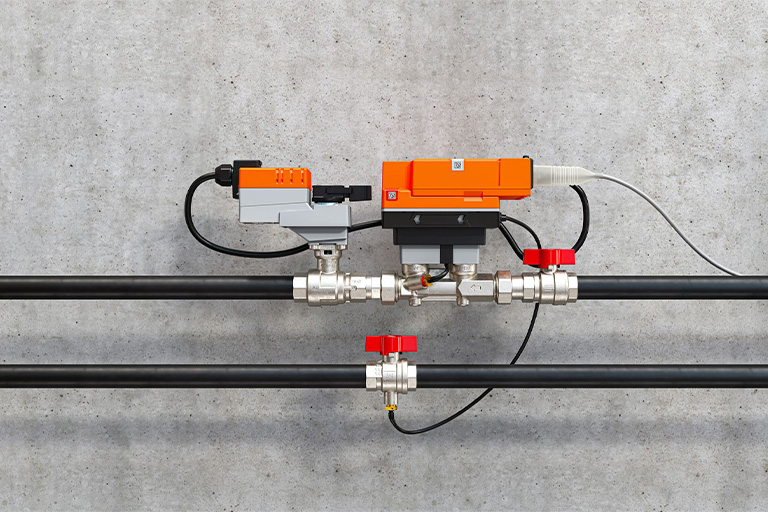
The Belimo Energy Valve communicates valve position, measured flow, and coil energy data via BACnet or Modbus, which makes it directly compatible with Critical Zone Reset implementations without requiring additional instrumentation.
What the Standard Does Not Specify
ASHRAE 90.1 does not specify valve type, actuator brand, or control protocol. The standard defines performance outcomes: flow shutoff capability, modulation range, pump power at partial load, temperature reset range. How those outcomes are achieved is left to the engineer.
This matters because it means compliance depends on system design and commissioning, not just product specification. A correctly specified Belimo characterized control valve or EPIV installed in a poorly designed system (with inadequate differential pressure, incorrect sizing, or a BMS that does not implement reset logic) does not produce a compliant system. The valve is necessary but not sufficient.
It also means that systems already in operation are subject to the mandatory provisions even if they were designed under an older version of the standard. Section 6.4 mandatory provisions apply to alterations and additions. Replacing terminal unit actuators, retrofitting zone isolation valves, or adding automatic isolation to a chiller plant all constitute work that triggers compliance with current mandatory requirements.
5 Common Gaps in Existing Systems
Based on the mandatory and prescriptive requirements above, several gaps appear frequently in commercial buildings that predate the current standard or were not fully commissioned:
- Two-position actuators on terminal units in DDC systems — common in older systems, they satisfy setback in a rough sense but prevent the pump differential pressure reset that 6.5.4.2 requires.
- No automatic isolation valves on water source heat pumps — a hard requirement that is frequently missing in retrofit and addition projects where the loop was extended without adding proper valve infrastructure.
- Chiller and boiler plants with manual isolation valves — operators open and close them manually, which means inactive equipment is sometimes bypassed and sometimes not, creating variable loop performance.
- No CZR logic in BMS — variable speed pumps are running at a fixed differential pressure setpoint rather than resetting to the most-open valve. The pump is doing more work than the standard requires.
- High close-off leakage on aging terminal unit valves — ghost flow through coils continues during unoccupied periods, eroding the energy savings that setback and shutdown controls are designed to produce.
Boston Aircontrols and Belimo Product Availability
Boston Aircontrols stocks Belimo control valves, characterized control valves (CCVs), electronic pressure independent valves (EPIVs), Energy Valves, and actuators across the range needed for 90.1-compliant systems. Same-day availability on most common sizes means valve replacements and retrofits can be executed without extended lead times.
For project specifications requiring close-off ratings, BACnet/Modbus-capable actuators, or pressure independent control for supply temperature reset applications, contact our technical team to confirm product selection against system parameters.
This post is for informational purposes only. Always confirm compliance against the adopted version of ASHRAE 90.1 in your jurisdiction, as states adopt different editions on different schedules.